
Whiplash: Where Does Mentorship End and Toxicity Begin?
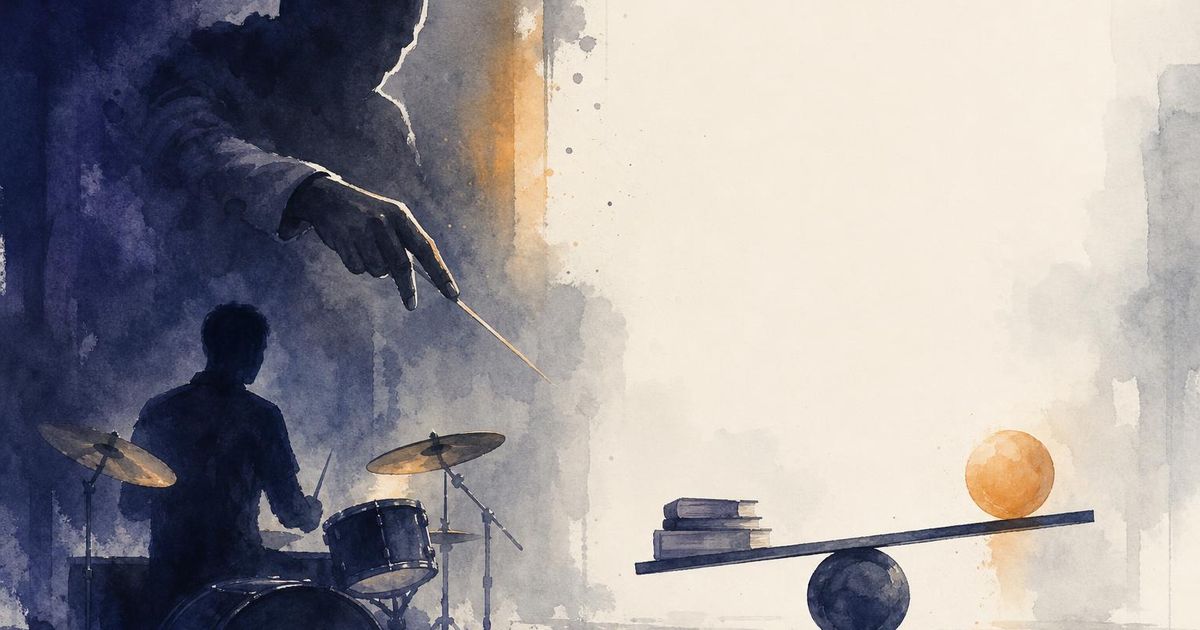
The Mentor Everyone Warns You About
You have heard the name before you ever meet them. "Brilliant but tough." "Old school." "They will make you better if you can survive them." In academic medicine, Whiplash mentorship is not just a movie trope. It is a lived experience that entire departments organize themselves around.
Terence Fletcher in Whiplash is the distilled version of this archetype. He knows more than anyone in the room. He has produced successful musicians. And he believes that his willingness to be cruel is what separates him from ordinary teachers. The scariest part is not the thrown chairs. It is how many people in the audience nod along when he explains himself.
I keep coming back to this film because it poses a question I hear from physician leaders constantly: where exactly is the line between pushing someone and breaking them?
The Excuse That Sounds Like a Philosophy
Fletcher tells Andrew near the end of the film that the two most dangerous words in the English language are "good job." His argument is that comfort breeds mediocrity. That the only way to find the next great talent is to push so hard that the weak ones fall away and the strong ones ignite.
There is a grain of truth in the idea that challenge builds competence. But Fletcher does not do challenge. He does demolition.
A 2014 study by Tepper, Simon, and Park in the Academy of Management Journal found that abusive supervision does not produce higher-performing employees. It produces employees who disengage, retaliate, or leave. The ones who stay and perform do so despite the abuse, not because of it. Fletcher's method does not forge greatness. It selects for people who happen to tolerate mistreatment.
In academic medicine, the distinction matters enormously. Toxic mentorship among physicians does not announce itself as abuse. It announces itself as standards.
Five Signs the Line Has Been Crossed
If you are a department chair, division chief, or program director, here is what I have observed separates mentorship from toxicity. The line is not about how hard you push. It is about what happens around the pushing.
Feedback is public and personal. Fletcher does not pull Andrew aside. He humiliates him in front of the ensemble. When your feedback is designed to make others witness someone's failure, it has stopped being development.
The goal keeps moving. Andrew can never satisfy Fletcher because satisfaction would end the dynamic. If your mentee meets every benchmark and you raise the bar without acknowledgment, you are not holding high standards. You are withholding approval as a control mechanism.
Fear is the primary motivator. People in Fletcher's studio do not play because they are inspired. They play because they are afraid. When your junior faculty are performing to avoid your reaction rather than to grow, the mentoring relationship has become coercive.
You cannot name what success looks like for them. Fletcher's vision of Andrew's success is indistinguishable from Fletcher's vision of his own legacy. If you cannot articulate a future for your mentee that does not center your department or your reputation, the mentorship has become extraction.
The relationship lacks repair. Every mentor-mentee relationship has hard moments. The question is whether there is a mechanism for coming back from them. Fletcher never repairs. He reloads.
What Departments Get Wrong
Toxic mentorship in academic medicine rarely survives because one person is a bad actor. It survives because the system around that person treats results as absolution.
Fletcher keeps his job because his ensembles win competitions. The abusive attending keeps their role because their trainees match well. The domineering PI keeps their lab because the grants keep coming. The institution looks at outcomes and decides the human cost is tolerable.
This is a systems problem, not just a personnel problem. Like a team whose defensive scheme only works because it injures its own players in practice, a department that tolerates toxic mentorship is not actually winning. It is borrowing against a future it cannot see yet -- the future where the next generation of faculty chooses to go somewhere else entirely.
Holding the Bar Without Holding the Hammer
You can be the toughest mentor in your institution and still be someone people seek out rather than survive. That combination is rare, which is why it is valuable. It requires three things Fletcher never had: self-awareness about your impact, genuine curiosity about what the other person needs, and humility to ask whether your methods are working -- not by your metrics, but by theirs.
If your department is wrestling with mentorship culture -- how to maintain rigor without crossing into harm -- that is exactly the kind of challenge that benefits from outside perspective. Learn about coaching for departments.