
What Gladiator Teaches About Purpose-Driven Leadership
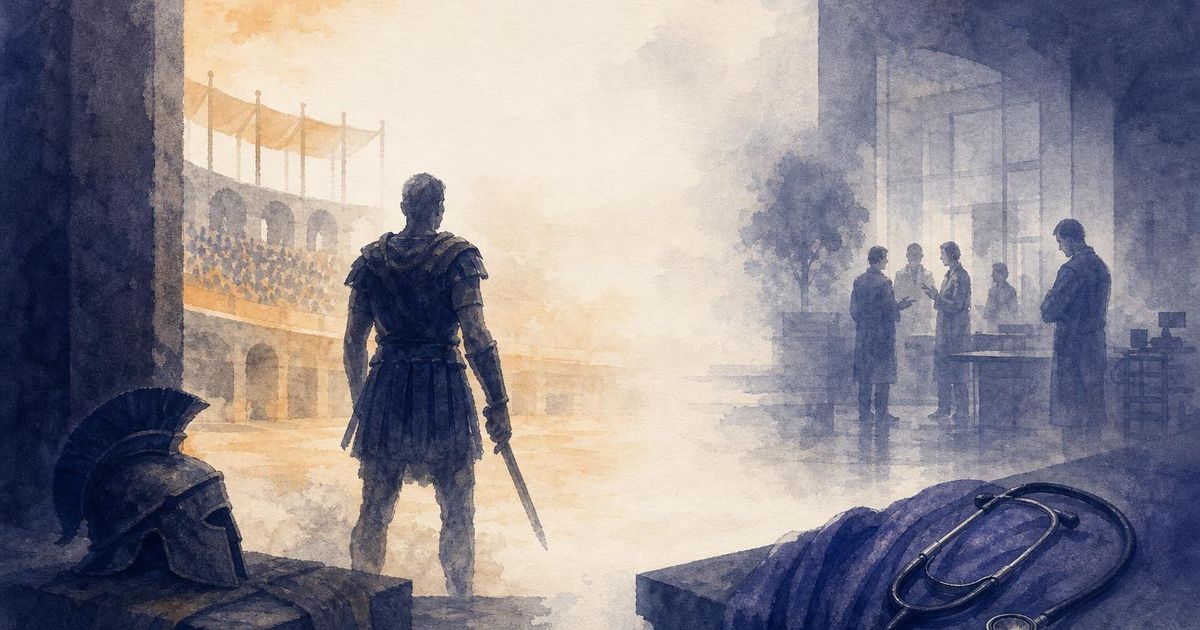
"What We Do in Life Echoes in Eternity"
Maximus says this line to his soldiers before the opening battle of Gladiator. It sounds like a motivational poster. But watch the scene again. He is not pumping them up. He is reminding them why they are there. Not for glory. Not for Rome's politicians. For something bigger than the fight in front of them.
That distinction matters more in academic medicine than most people realize.
Purpose Is Not the Same as Position
When Maximus is a general, his purpose and his position are aligned. He leads Rome's armies because he believes in what Rome could be. Marcus Aurelius shares that vision. The work makes sense.
Then everything is taken. His command. His family. His freedom. He is branded, sold, and thrown into a gladiator pit in North Africa.
Here is what does not change: his sense of purpose.
Maximus does not fight in the arena because he loves combat. He fights because he is trying to get to Rome. To fulfill the dying wish of Marcus Aurelius. To serve something larger than his own survival. The title is gone, but the purpose remains intact.
I work with physician leaders who hit a version of this wall. Not enslavement, obviously. But the loss of a leadership role after a reorganization. A program directorship eliminated in a budget cut. A mentor who retires and suddenly nobody in the institution champions their work. The position disappears, and with it, the sense of direction.
The physicians who recover fastest are the ones whose sense of purpose was never fully dependent on the position. They know why they do the work, not just what the work is.
Commodus Had Every Title. He Had No Purpose.
Emperor Commodus is the perfect counterpoint. He holds the most powerful position in the known world. And he is completely lost. He craves approval from the Senate, from the crowd, from the ghost of a father who never respected him. Every decision he makes is about protecting his status.
Commodus is what happens when position becomes the purpose.
You have seen this in academic medicine. The department chair who fights to keep the title but has no vision for where the department should go. The physician leader who accumulates committee seats and administrative roles but cannot articulate what they are building. William Damon writes about this in The Path to Purpose -- that people who anchor their identity in external markers of success are the most vulnerable when those markers shift. Commodus is a case study.
The Arena Stripped Everything Away
What makes the gladiator scenes so compelling is that the arena is a perfect meritocracy of character. Nobody cares about your former rank. There is no org chart. There is just you, the sand, and the question of what you are made of.
Maximus organizes the other gladiators not because anyone asks him to. He does it because keeping people alive is who he is. That purpose -- protecting others, serving something beyond himself -- shows up whether he is commanding legions or fighting for survival.
For physician leaders, the equivalent of the arena is any moment when the institutional scaffolding falls away. When you lose the grant, the title, the protected time. When you are back to being one clinician among many. What drives you then?
If the answer is "nothing, because my role was the point," that is worth examining. If the answer is "the same thing that drove me before I had the role," you are standing on solid ground.
Purpose Outlasts Position
Here is the practical takeaway. Positions in academic medicine are temporary. Reorganizations happen. Chairs rotate. Funding cycles end. Strategic priorities shift, and yesterday's centerpiece initiative becomes today's budget line to cut.
Purpose does not reorganize.
The physicians I coach who build durable careers do a few things differently:
- They can articulate their purpose in one sentence. Not a mission statement. A real answer to "why do you do this work?"
- They make decisions through that lens. When an opportunity arises, they ask whether it serves the purpose or just adds a line to the CV.
- They hold positions loosely. They pursue leadership roles, but they do not confuse the role with the reason.
Maximus wanted to restore the Roman Republic. That purpose guided him as a general, as a slave, and as a gladiator standing in the Colosseum with the emperor's life in his hands. The setting changed completely. The purpose never did.
Find Your Rome
You do not need to topple an emperor. But you do need to know what your version of Rome is. The thing you are trying to build or protect or restore that exists independent of any title on your door.
If that feels unclear right now, that is not a failure. It is a starting point. Clarifying purpose is one of the most practical things a physician leader can do, and it changes how you navigate every institutional challenge that follows.
If you'd like to learn more, contact us to schedule a time to chat.