
The Founding Fathers and the Art of Principled Compromise
Everyone Wants to Be Right
You are sitting in a conference room with eight people who each have a perfectly valid reason their priority should come first. The surgeon wants more OR time. The internist wants protected teaching hours. The researcher wants startup funds. The administrator wants to close a budget gap. Everyone has data. Everyone has conviction. And the meeting has been going for ninety minutes with no resolution.
Welcome to the Constitutional Convention of your department.
The Room Where It Happens
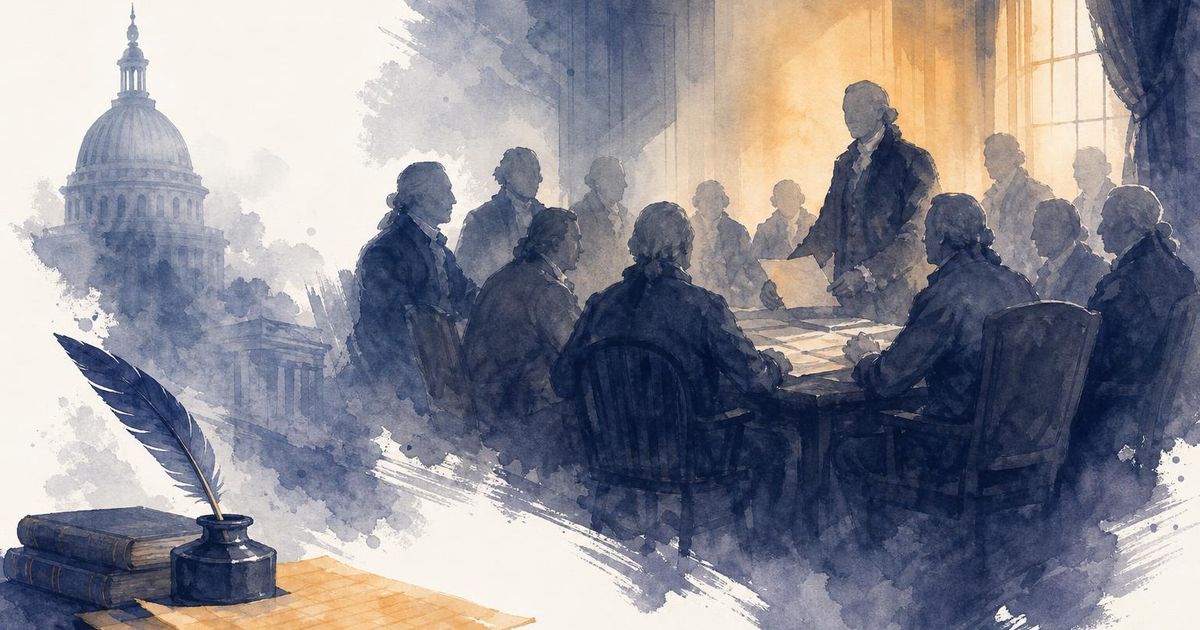
Lin-Manuel Miranda's Hamilton captures something most history classes miss about the founding of the United States. The Constitution was not the product of shared vision. It was the product of exhausted, frustrated people who disagreed on nearly everything but managed to find enough common ground to move forward.
The musical's "The Room Where It Happens" dramatizes the Compromise of 1790 -- Hamilton trading the capital's location to Jefferson and Madison in exchange for federal assumption of state debts. Neither side loved the deal. Both sides got something they needed. The country moved forward.
The 1969 musical film 1776 makes the same point even more starkly. John Adams, who is right about independence and knows it, has to watch the Continental Congress water down his declarations and delay his timelines. Benjamin Franklin tells him plainly: "What do you want, Mr. Adams? Perfection, or the Declaration of Independence?"
That question should be tattooed on the wall of every academic medicine conference room.
Principled Compromise Is Not Weakness
There is a reason physician leaders resist compromise. In clinical medicine, precision matters. You do not compromise on a diagnosis. You do not split the difference on a treatment plan. The right answer is the right answer.
But leadership is not clinical medicine. In leadership, you are dealing with legitimate competing goods, not right versus wrong. Roger Fisher and William Ury made this distinction foundational in Getting to Yes: Negotiating Agreement Without Giving In. The most effective negotiators do not fight over positions. They identify underlying interests and look for solutions that address multiple interests simultaneously.
Hamilton cared about financial solvency, not geography. Jefferson cared about Virginia's influence, not debt policy. Once they stopped arguing positions and started trading on interests, a deal became possible.
Three Moves That Build Consensus
I work with physician leaders who are stuck in exactly this dynamic -- talented, principled people locked in positional standoffs. Here is what works:
- Name what you are willing to give up. Going first with a concession signals strength, not weakness. It tells the room you are serious about a deal, not just about winning.
- Separate the person from the proposal. Adams hated almost every compromise the Continental Congress forced on him. But he kept showing up, kept engaging, and kept the relationships intact enough to get the Declaration signed. You can disagree with someone's plan without treating them as an adversary.
- Define the non-negotiables before the meeting. If you walk in knowing your three deal-breakers and your three flexible points, you can negotiate fluidly. If everything is a hill to die on, nothing gets done.
The Slavery Clause Problem
Here is where the analogy gets uncomfortable, and where it gets useful.
The Constitutional Convention's greatest compromise was also its greatest moral failure. The framers compromised on slavery to preserve the union. That decision had consequences that echoed for centuries.
Not every compromise is principled. Some things should not be traded away. The skill of leadership is knowing the difference between a preference you can flex on and a value you cannot.
In academic medicine, that line exists too. You can compromise on budget allocations, office space, and scheduling. You should not compromise on trainee safety, research integrity, or equity in hiring and promotion. A 2020 article in Academic Medicine by Lucey et al. argued that institutions must be explicit about which values are foundational and which priorities are negotiable -- because without that clarity, everything becomes transactional.
You Will Not Get a Perfect Document
Adams did not get his perfect Declaration. Hamilton did not get his perfect financial system. Madison did not get his perfect Constitution. What they got was a working framework that could be amended over time.
Your strategic plan will not be perfect either. Your new clinical schedule will have gaps. Your compromise on faculty workload will leave someone unhappy.
The question is not whether the result is ideal. The question is whether it moves the institution forward in a way that preserves the relationships and values you need for the next negotiation. Because there is always a next negotiation.
If you'd like to learn more, contact us to schedule a time to chat.