
A League of Their Own and What It Takes to Be Taken Seriously
They Were Never Supposed to Matter
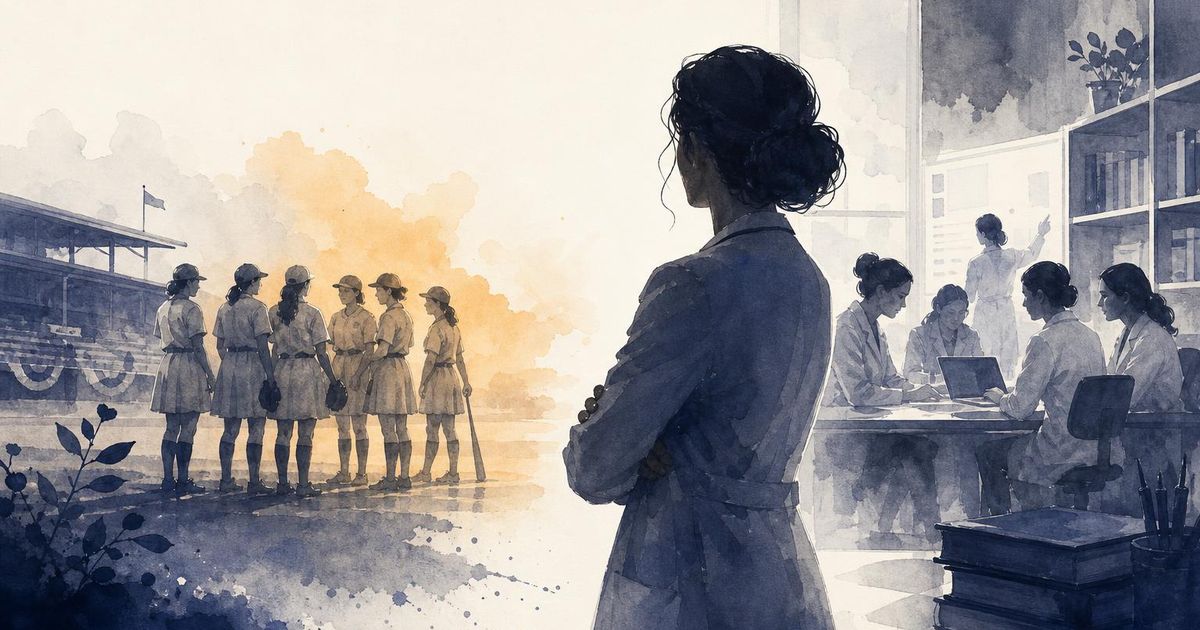
The All-American Girls Professional Baseball League was created as a placeholder. The men were at war. The stadiums were empty. The owners needed warm bodies on the field to sell tickets until the real players came home.
That is the setup of A League of Their Own. And if you have ever been a woman in academic medicine trying to get a seat at the leadership table, you probably recognized the dynamic before the first inning was over.
Playing Twice as Hard for Half the Credit
The Rockford Peaches had to do something no men's team was ever asked to do. They had to prove that the game itself was worth watching when they played it. Not just win. Not just perform. But justify the entire premise that they belonged on the field at all.
Dottie Hinson, played by Geena Davis, is the best player in the league. Everyone knows it. And yet her legitimacy is constantly questioned. She is asked to play in a skirt. To attend charm school. To smile for the cameras. The message is clear: your talent is necessary, but it is not sufficient. You also have to make everyone comfortable with the fact that you have it.
I hear versions of this from women in academic medicine more than I should. The physician who publishes more than anyone in her division but gets passed over for the leadership role in favor of someone with half her CV. The surgeon who is told she is "too direct" in the same department where her male colleagues are praised for being decisive. The researcher who is asked to take notes in the meeting where she has the most expertise.
A 2020 study published in JAMA Network Open found that women physicians were significantly less likely to hold leadership positions even after controlling for experience, productivity, and specialization. The pipeline is not the problem. The filter is.
The Charm School Problem
One of the most telling scenes in the film is charm school. The players are pulled off the field to learn etiquette. How to sit. How to pour tea. How to be likable enough that the public would accept women playing baseball.
Academic medicine has its own version of charm school. It is rarely this explicit, but the expectation is there. Women in leadership are frequently coached, formally or informally, to soften their communication style. To be collaborative but not too assertive. To be confident but not intimidating. To lead but not in a way that makes anyone uneasy.
Joan C. Williams and Rachel Dempsey wrote about this double bind extensively in What Works for Women at Work. They call it the tightrope: the impossibly narrow path between being seen as too feminine to be competent and too masculine to be likable. The research on this is not new. The problem persists anyway.
Jimmy Dugan Woke Up Eventually
Tom Hanks plays Jimmy Dugan, a washed-up manager who starts the season barely conscious in the dugout. He does not take the team seriously. He does not take the league seriously. He is there for the paycheck.
But he changes. Slowly and imperfectly. He starts seeing the players as athletes, not as a sideshow. He starts coaching them like they matter. And when he does, the team gets better. Not because the players were not already talented. But because having a leader who actually invested in them unlocked what was already there.
This is what allyship looks like in academic medicine. Not grand gestures. Not performative statements about equity. It looks like a department chair who notices that the same three people keep getting nominated for leadership roles and asks who is being overlooked. It looks like a division chief who stops accepting "culture fit" as an explanation for why a qualified woman was not selected. It looks like a senior faculty member who uses his credibility to amplify a colleague's work instead of just his own.
"It's Supposed to Be Hard"
Dottie tries to quit near the end of the film. Jimmy stops her with one of the most quoted lines in movie history: "It's the hard that makes it great."
I want to be careful with this one. Because too often in academic medicine, "it's supposed to be hard" becomes an excuse for institutions to avoid fixing things. Yes, leadership is hard. But there is a difference between the inherent difficulty of leading a department and the manufactured difficulty of having to prove your legitimacy every single day.
The hard part should be the work itself. Not the fight to be seen as someone who can do it.
What Actually Changes the Dynamic
Individuals cannot fix structural problems alone. But structures are maintained by individuals who either challenge them or accept them. A few things that move the needle:
- Sponsorship, not just mentorship. Mentors give advice. Sponsors spend political capital. Women in academic medicine are often over-mentored and under-sponsored. If you are in a position of influence, put someone's name forward for an opportunity they did not ask for.
- Transparent criteria. When leadership selection is subjective, bias fills the gaps. Make the criteria explicit. Evaluate candidates against the criteria, not against an unconscious prototype of what a leader looks like.
- Believe the data. Your department may feel equitable. The numbers may tell a different story. Look at who gets promoted, who gets protected time, who gets the high-visibility projects. If the patterns are skewed, the system is producing them.
They Were Always Legitimate
The Rockford Peaches did not need anyone's permission to be great. They needed the institution to stop treating their greatness as a novelty. The same is true for women in academic medicine right now.
The talent is not the problem. The question is whether your institution is structured to see it, develop it, and put it in positions of real authority.
If you are a woman navigating this, you are not imagining the double standard. And if you are a leader with the power to change the structure, the crowbar is in your hands.
Learn about how coaching for departments can support faculty through the hardest transitions.